Deaddiction
The Bhavnagar Hooch Tragedy (Lattha kand): What Methanol Does to the Body — And the Addiction Crisis Behind Every Illicit Drink
Dr. Dharmin Shah24 August 2026
Our city is grieving. Families have lost people they loved. But behind every tragedy like this one, there is a story that rarely gets told — of dependency, of desperation, and of a condition that medicine can treat, if only we give it the chance.
Bhavnagar is grieving right now.
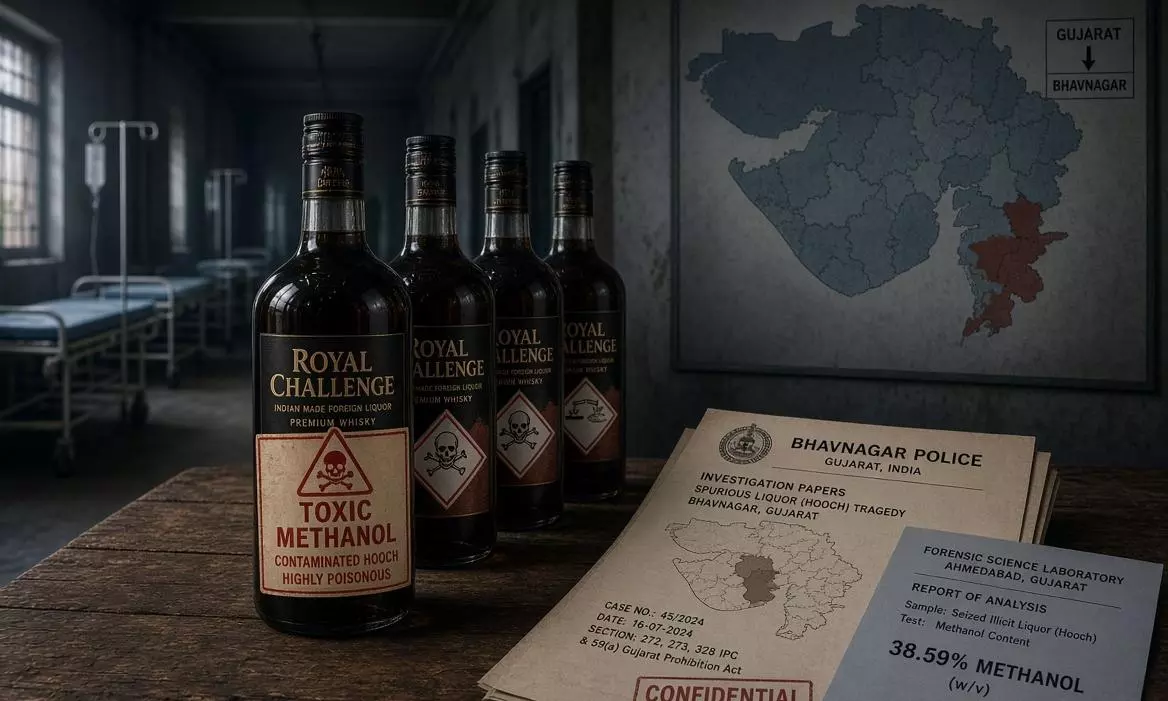
What is being called the Bhavnagar Lattha Kand — the spurious liquor tragedy / Hooch Tragedy that shook our city in August 2026 — has left families shattered and an entire community asking difficult questions. On the night of August 16, three friends consumed illicit liquor in Vartej. All three fell ill. One of them did not survive. In the days that followed, the scale of the Vartej Lattha Kand became painfully clear. 61 persons were affected by the methanol laced spurious liquor. Eight lives were lost. Ten patients landed in the ICU, one of them on a ventilator. Twenty five people continued undergoing treatment even after the initial crisis broke.
We are writing this not to revisit the pain of what happened, but because the Bhavnagar Lattha Kand holds within it a question that nobody is asking loudly enough.
Why were people drinking that illicit liquor in the first place?
And more importantly — could this have ended differently?
What methanol poisoning actually does — and why it is so devastating
Alcohol that people drink is ethanol. A compound that, while addictive and harmful in excess, the body can process in limited amounts. Methanol is something else entirely. It is an industrial chemical, used in manufacturing and as a fuel. The Forensic Science Laboratory report confirmed that the spurious liquor circulating in Bhavnagar contained 38.59% methanol and only 0.94% ethanol. What was sold and consumed as alcohol was almost entirely poison.
Methanol poisoning works in a particularly cruel way. When methanol enters the body, it gets broken down into formaldehyde and then formic acid, substances that attack the nervous system, destroy the optic nerve, and cause the body's internal chemistry to collapse. The symptoms begin deceptively mildly — nausea, headache, blurred vision and then escalate with terrifying speed into blindness, seizures, and organ failure. The window between feeling unwell and a life-threatening emergency can be just a matter of hours.
This is not what anyone drinks hoping to experience. And yet, people did drink it because when the need for alcohol is desperate enough, questions about what is actually inside the bottle stop feeling relevant. That desperation has a name. It is called alcohol dependency. And it is a medical condition not a character flaw.
Gujarat is a dry state. So why did the Lattha Kand happened?
Gujarat is a dry state where the manufacture, sale, and consumption of alcohol is banned. And yet illicit liquor deaths in Gujarat are not new. The Bhavnagar Lattha Kand of 2026 is a tragedy, but it is not without precedent — and that pattern should disturb all of us.
The reason these incidents keep recurring is not simply the criminality of bootleggers though that is undeniably part of it. The deeper, less discussed reason is that prohibition does not extinguish addiction. It only drives it underground, removing every safeguard from what dependent individuals end up consuming.
A person who is physically dependent on alcohol does not stop needing it because a law says no. They find another way. A cheaper way. An unregulated, dangerous way. In that desperation, the Bhavnagar Lattha Kand was not an accident waiting to happen, it was the predictable destination of untreated alcohol addiction, where there was no safe, legal, medically supervised alternative available.
This is where our role as a de-addiction centre in Bhavnagar becomes deeply relevant.
The physicians treating methanol poisoning in ICUs across the city are doing everything medicine can do after the tragedy has already occurred. That is their expertise and it is life saving work. But our work sits at a completely different and earlier point in this story, before the bootlegger, before the bottle, before the irreversible decision.
If even some of the individuals affected by the Bhavnagar Lattha Kand had accessed alcohol de-addiction treatment in Bhavnagar before August 16th, they would not have been in the position where illicit hooch felt like the only option available to them. Methanol poisoning Bhavnagar families are now dealing with is, in many painful ways, the destination that untreated alcohol dependency can arrive at. That destination was never inevitable.
Alcohol dependency is a medical condition — not a moral failure
When a person drinks heavily and repeatedly over time, the brain begins to adapt its chemistry around the presence of alcohol. Neurotransmitter balances shift. The brain recalibrates its baseline. Eventually, the absence of alcohol triggers genuine physiological withdrawal — anxiety, sweating, tremors, and in severe cases, seizures.
At this stage, stopping is no longer simply a matter of deciding to stop. The brain has been physically altered. The craving is not weakness — it is the brain responding exactly as it has been conditioned to respond, over months or years of drinking. In a state where legal alcohol is banned, that same craving pushes people toward illicit liquor in Gujarat — toward whatever is available, regardless of what it contains.
The people affected by the Vartej Lattha Kand were not reckless or foolish. Many of them were likely dependent — trapped in a cycle the body had quietly built around them, one drink at a time. And in the absence of de-addiction support, that cycle led them exactly where it leads so many others — to a source with no quality, no oversight, and no accountability.
To the family that has known for a long time
Every addiction has a family standing behind it. A spouse who has watched years go by hoping things will change. A parent hiding money in a different place each month. Children who learned very early to read the mood in the house the moment the front door opens.
If you are a family in Bhavnagar or anywhere in the Saurashtra region, and you have been living alongside someone's alcohol dependency in silence — the Bhavnagar Lattha Kand is the moment to stop waiting. Not with anger. Not with ultimatums. But with the clear-eyed understanding that alcohol use disorder is a medical condition, and medical conditions have treatment pathways that work.
Shame has never cured addiction. It has only delayed the moment someone finally reaches out for help.
What alcohol de-addiction treatment in Manas Hospital, Bhavnagar actually looks like
At our de-addiction centre in Manas Hospital, Bhavnagar, treatment begins with medically supervised detoxification. This step is critical — abruptly stopping alcohol in a heavily dependent person without medical supervision can itself be dangerous. Withdrawal is managed safely with medication, protecting the patient while their body finds its footing again.
What follows is the deeper, more sustained work — identifying the triggers behind the drinking, rebuilding healthy coping mechanisms, addressing underlying mental health conditions like depression or anxiety that silently fuel alcohol use disorder, and supporting both the patient and their family through the recovery process. Medication-assisted treatment, Interventional treatment like rTMS, individual counselling, group therapy, and structured family involvement all form part of a treatment plan designed for real, lasting recovery — not just short-term sobriety.
The Bhavnagar Lattha Kand did not begin on August 16th
It began much earlier — in the quiet accumulation of dependency that went untreated, in the shame that kept families silent, in the assumption that illicit alcohol was simply a lifestyle choice rather than the symptom of a condition that medicine knows how to address.
The physicians managing methanol poisoning are doing heroic work at one end of this story. We are here at the other end — the earlier end, where the story can still be changed.
If you or someone in your family is dependent on alcohol, please do not wait for a wake-up call that arrives too late. Reach out to our de-addiction centre in Manas Hospital, Bhavnagar. We will listen without judgement, assess without shame, and offer a medically grounded path toward recovery.
The Bhavnagar Lattha Kand has taken enough from this city. Let it also be the moment that saves someone who still has the chance to be saved.
More from the journal
Child & Adolecent
The Silent Struggle in Every Classroom: A Parent and Teacher’s Guide to School Children’s Mental Health
Read
Mental Health
On World Suicide Prevention Day — Start the Conversation. It Can Save a Life.
Read
Mental Health