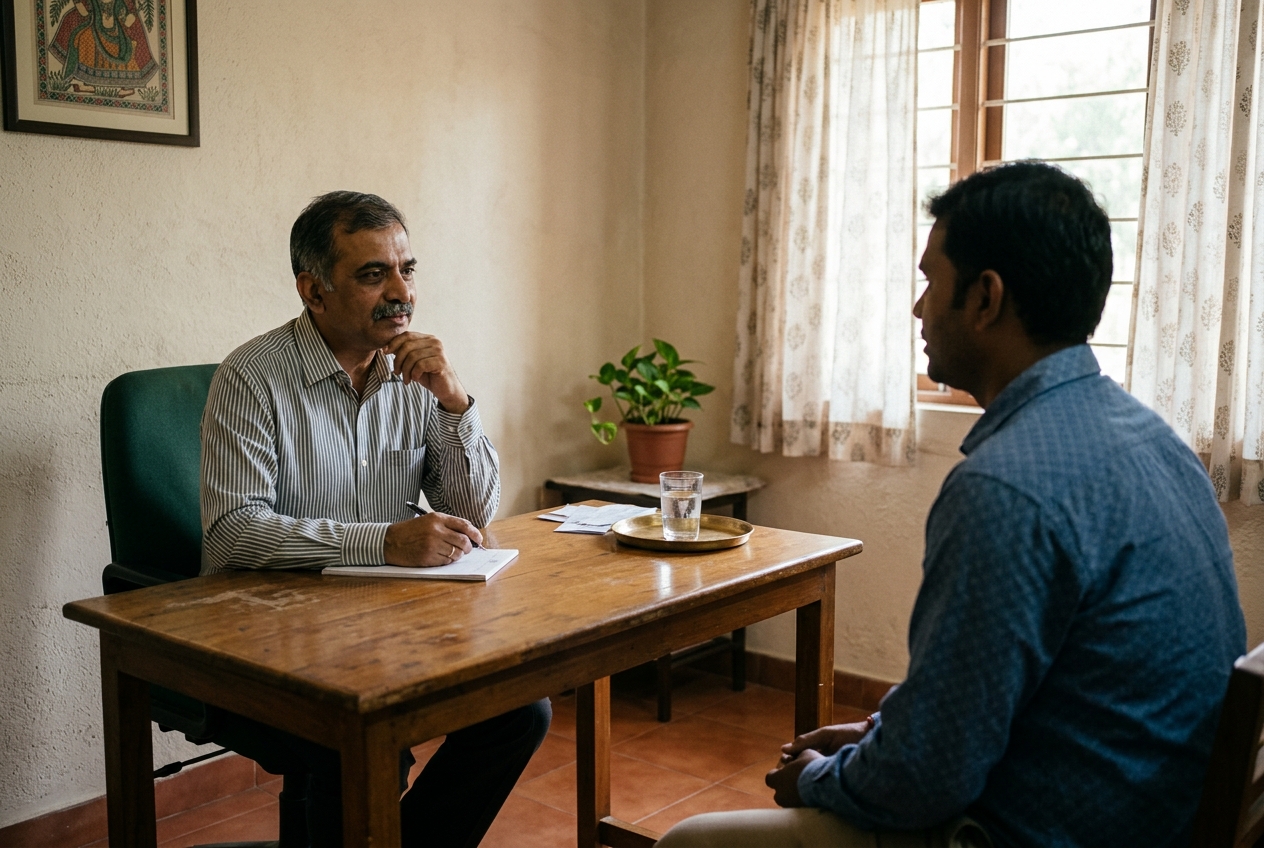
Most minds don't need a hospital bed. Just a good doctor.
The everyday psychiatry OPD at Manas, Bhavnagar — depression, anxiety and panic, OCD, sleep problems, bipolar disorder, psychosis, childhood behavioural concerns, memory loss in the elderly and women's mental health. Diagnosed properly, treated on an outpatient basis, followed up until you are well.
Over one lakh consultations across two generations of psychiatrists.
Conditions We Treat in OPD
Twelve common reasons people come to us.
Nearly every condition below is treated on an outpatient basis — you come, you are assessed, you go home with a plan. Admission is the exception, not the rule.
Depression
What it looks likePersistent low mood, loss of interest, fatigue, disturbed sleep or appetite, guilt, poor concentration, thoughts of self-harm.
How we treat itOPD treatment with antidepressants where indicated, cognitive behavioural therapy, and structured follow-up. Most patients improve within 4–8 weeks; severe or treatment-resistant cases can be escalated to our rTMS suite.
What it looks likeEpisodes of elevated mood, reduced need for sleep, over-spending or risk-taking, alternating with depressive phases.
How we treat itLong-term mood stabilisers, psychoeducation, mood charting and sleep-routine work. Reviewed every few weeks in OPD to keep you stable for years, not weeks.
What it looks likeConstant worry, restlessness, palpitations, breathlessness, chest tightness, fear of dying, avoiding travel or crowds.
How we treat itMost panic patients first visit a cardiologist. Once the heart is cleared, SSRIs plus CBT with interoceptive exposure restore normal function — usually within 8–12 weeks of OPD treatment.
What it looks likeRepeated washing, checking, counting or arranging; intrusive unwanted thoughts; hours lost to rituals.
How we treat itHigh-dose SSRIs with exposure and response prevention therapy. For resistant OCD we add FDA-approved rTMS protocols — available in Bhavnagar at our own neuromodulation suite.
What it looks likeHearing voices, suspiciousness, delusional beliefs, muttering to self, social withdrawal, self-neglect.
How we treat itEarly antipsychotic treatment, long-acting injectables when daily tablets are missed, family psychoeducation and vocational rehabilitation. The earlier treatment starts, the better the long-term outcome.
What it looks likeOverwhelming reaction after a loss, exam failure, job crisis, accident or relationship breakdown; crying spells, hopelessness, inability to function.
How we treat itShort-term, focused OPD support — counselling, sleep restoration and brief medication where needed. Many patients need only a few visits.
What it looks likeDifficulty falling or staying asleep, unrefreshing sleep, daytime fatigue, dependence on sleeping pills.
How we treat itWe treat the cause, not just the symptom: Cognitive Behavioural Therapy for Insomnia (CBT-I), screening for sleep apnoea, thyroid problems and medication effects, and a plan to taper long-term sedatives safely.
What it looks likeRepeated physical complaints with normal reports, body aches, burning sensations, tension headache, migraine, giddiness.
How we treat itGenuine symptoms with a neuropsychiatric basis. Treated with appropriate medication, relaxation training and a clear explanation — no more endless investigations.
What it looks likeForgetfulness, repeated questions, getting lost, suspiciousness of family, night-time restlessness, late-life depression.
How we treat itCognitive assessment, reversible-cause screening, cognitive enhancers where useful, and above all caregiver training — because families carry most of this illness.
What it looks likeADHD and inattention, autism spectrum concerns, school refusal, falling grades, temper tantrums, bedwetting (enuresis), oppositional behaviour, exam anxiety.
How we treat itFamily-centred OPD care working with parents and teachers. Interventions are mostly behavioural; medication is used judiciously and only when truly indicated.
What it looks likePost-partum depression, severe pre-menstrual mood change (PMDD), menopausal anxiety and sleeplessness, infertility-related distress.
How we treat itTreatment that respects pregnancy and breastfeeding safety, coordinated with your gynaecologist where required, in a private consultation.
What it looks likeTalking about being a burden, giving away belongings, hopelessness, a previous attempt, sudden calm after severe distress.
How we treat itTreat this as an emergency, not a phase. Call +91 94275 60101 — we provide same-day assessment, safety planning, and rapid-acting options including ketamine infusion for active suicidal ideation.
A psychiatry OPD that runs on time and on evidence.
Same-week OPD slots
No referral needed. Walk in, call, or request an appointment online — Mon to Sat, 9 AM to 8 PM.
MD-qualified psychiatrists
Consultations by Dr. Kamlesh A. Shah (MD, since 1989) and Dr. Dharmin K. Shah (MD, TMS Physician — AIIMS, New Delhi).
Transparent fees
A standard consultation fee. No packages, no unnecessary tests, no pressure to admit.
Strict confidentiality
Your records are never shared with family, employers or anyone else without your written consent.
What to expect
Your OPD visit, step by step.
01
Step 1 — Booking
Call, walk in, or request a slot online. No referral letter and no waiting list for routine OPD.
02
Step 2 — Assessment
A 45–60 minute consultation: history, mental state examination and, where relevant, blood tests or a scan to rule out physical causes.
03
Step 3 — Diagnosis, explained
You are told what you have, in plain Gujarati or English, along with what it is not. Family is included only if you want them to be.
04
Step 4 — Treatment plan
Medication where it genuinely helps, therapy where it works better, and lifestyle and sleep correction. Costs and duration are stated upfront.
05
Step 5 — Follow-up
Reviews every 2–4 weeks initially, then spaced out as you improve. Dose reduction and stopping are planned, not accidental.
Beyond the OPD
If tablets alone haven't worked, there is more we can do.
Manas is the only centre in the region offering rTMS, tDCS and ketamine infusion alongside a routine psychiatry OPD — plus a medically supervised deaddiction programme and a confidential sexology clinic.
A psychiatry OPD for Bhavnagar and all of Saurashtra.
Patients travel to Manas Neuropsychiatry Hospital, Kalanala, from Bhavnagar city, Sihor, Palitana, Talaja, Mahuva, Gariadhar, Botad, Amreli, Rajkot, Surat and across Gujarat for psychiatric assessment, deaddiction treatment and neuromodulation.
You don't have to be in crisis to deserve help.
Book a routine psychiatry consultation today — Mon to Sat, 9 AM to 8 PM.