tDCS · Low-intensity · Gentle
The gentlest tool in the suite.
Transcranial Direct Current Stimulation passes a very weak constant current — typically 1 to 2 milliamperes, a small fraction of what rTMS delivers — between two sponge electrodes on the scalp. It does not fire neurons; it gently nudges them towards being easier or harder to fire. That makes it painless, extremely well tolerated, and particularly useful in combination with therapy, cognitive training and craving management.
Neuromodulation Suite · Bhavnagar
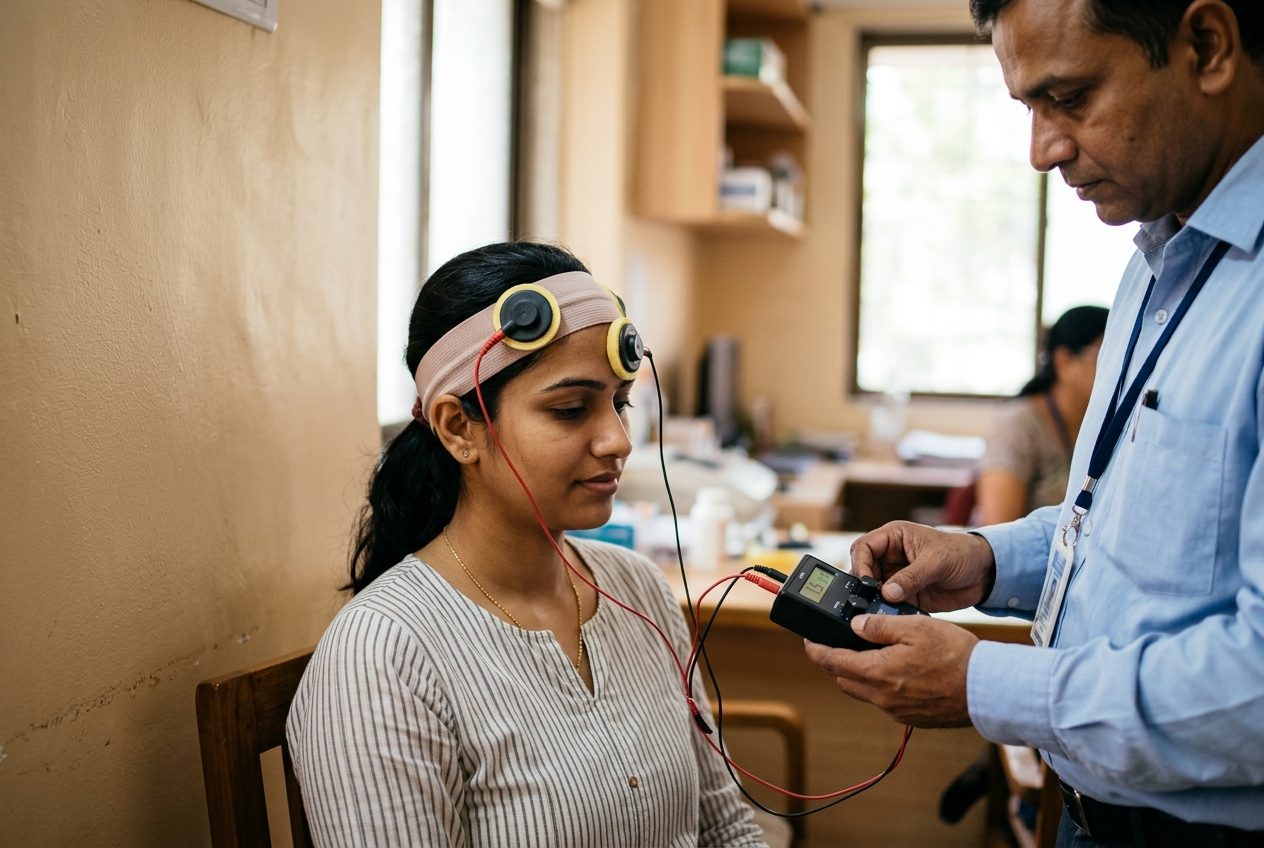
Two sponge electrodes, a current you can barely feel, and a 20-minute session you can read through.
How it works
The science, without the mystery.
It shifts excitability, it does not force firing
The anode makes the cortex underneath slightly more likely to fire; the cathode makes it slightly less likely. Nothing is forced — which is why the current is imperceptible beyond a mild tingle.
It works best while the brain is busy
Because tDCS only biases activity, we pair it with an active task — cognitive exercises, speech or hand rehabilitation, or craving-exposure work — so the circuit being stimulated is the circuit being used.
Repetition builds the change
A single session lasts hours; a course of daily sessions produces cumulative plasticity. This is why tDCS is prescribed as a block of sessions rather than a one-off.
Who it is for
Where this treatment genuinely helps.
Commonly used for
- Mild to moderate depression, especially when medication is not tolerated
- Alcohol, tobacco and opioid craving during deaddiction treatment
- Cognitive rehabilitation after stroke or traumatic brain injury
- Persistent auditory hallucinations in schizophrenia
- Chronic pain, fibromyalgia and refractory migraine
Why patients are offered it
- No anaesthesia, no sedation, no systemic side-effects
- Substantially lower cost per session than rTMS
- Safe to combine with existing medication and therapy
- Suitable when a pacemaker rules out other options, after assessment
- Sessions can be scheduled twice a day to shorten a course
- Usable in older patients and in adolescents where appropriate
What a course looks like
Step by step, start to finish.
- 01
Assessment and target selection
A psychiatric and, where relevant, cognitive assessment decides which cortical target and which electrode montage suits your problem. Scalp skin and any implants are checked.
- 02
The session
Saline-soaked sponge electrodes are held in place by an elastic band, current is ramped up over 30 seconds, and 20–30 minutes pass while you sit, read or do the paired task.
- 03
Course of 10–20 sessions
Daily or twice-daily sessions on weekdays, with symptom or cognitive scores repeated at the midpoint so progress is measured rather than assumed.
- 04
Review and maintenance
At the end of the block we decide honestly whether to continue, switch to rTMS, or rely on medication and therapy alone.
Safety
Side-effects and limits, stated plainly.
Possible side-effects
- Tingling, itching or a mild warm sensation under the electrodes
- Transient redness of the scalp skin where the sponge rested
- Mild headache or fatigue after a session, in a minority of patients
- Brief phosphene — a flicker of light — as the current is switched on
When we will not do it
- Metal implants, plates or clips in the head
- Skin disease, open wounds or infection at the electrode site
- Implanted pacemaker or defibrillator, unless specifically cleared
- Poorly controlled epilepsy
Please read this
tDCS is safe but not magic: consumer 'brain-boosting' headsets sold online are unregulated and use uncontrolled montages. Stimulation should be prescribed and supervised, with the target, current and duration chosen for your diagnosis.
Frequently asked
What patients and families always ask.
Find out if you are a candidate.
A 30-minute eligibility consultation at Kalanala, Bhavnagar. Honest answers, written costs, no pressure.