Neuropsychiatry · Since 1989
ગુજરાતીમાં વાંચોWhen the illness is in the brain, not only in the mind.
Epilepsy with depression. Rage after a head injury. A father who sits silently since his stroke. A young woman who became psychotic in four days. These are not failures of character or faith — they are brain conditions, and they are the reason this hospital has the word neuropsychiatry in its name.
MD Neuropsychiatry · Kalanala, Bhavnagar
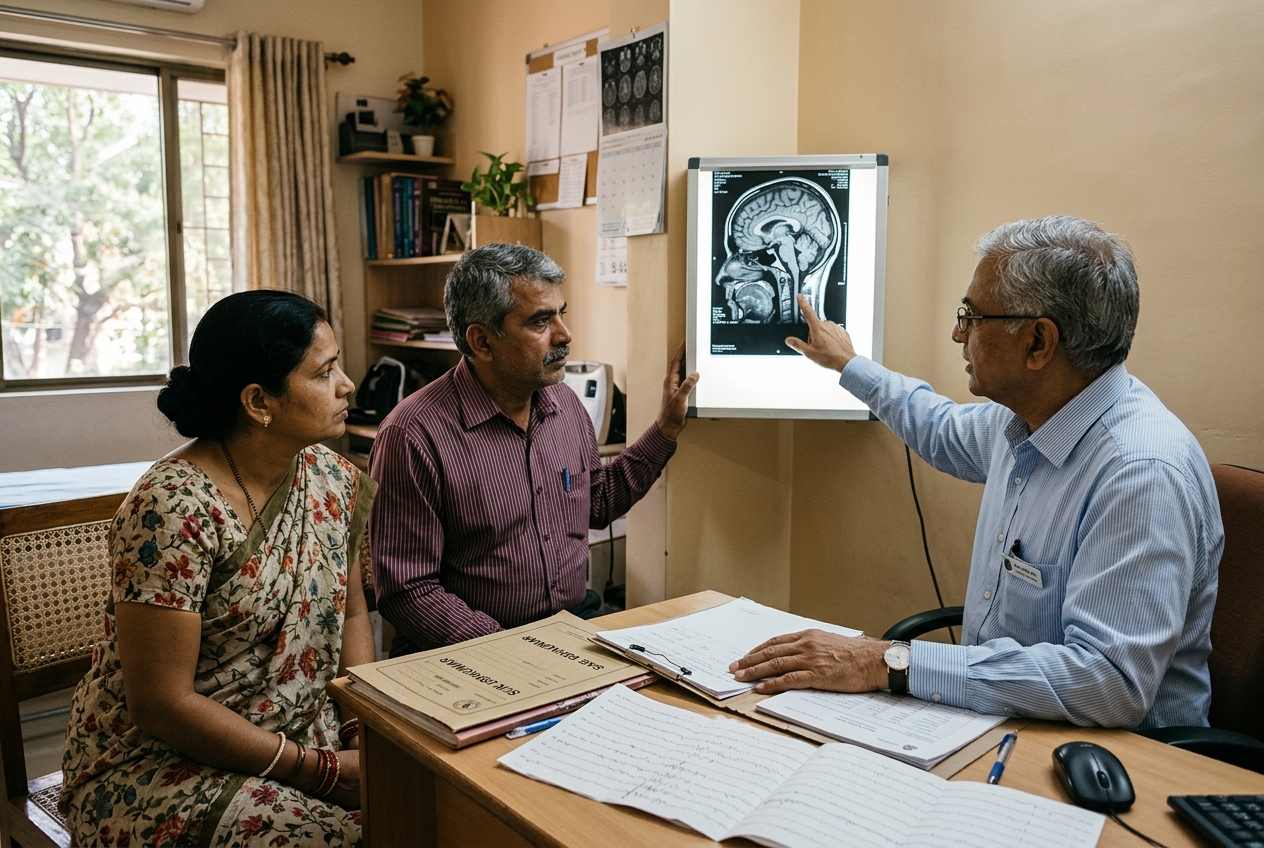
The scan is read with the patient in the room — not posted as a label.
What a general clinic cannot do
A psychiatric label should be the last step, not the first.
Brain tumours, autoimmune encephalitis, Wilson's disease, thyroid disorders and vitamin deficiencies have all been treated for months as schizophrenia or bipolar disorder. The difference is not luck — it is whether anybody examined the brain before the prescription.
The brain is examined, not assumed
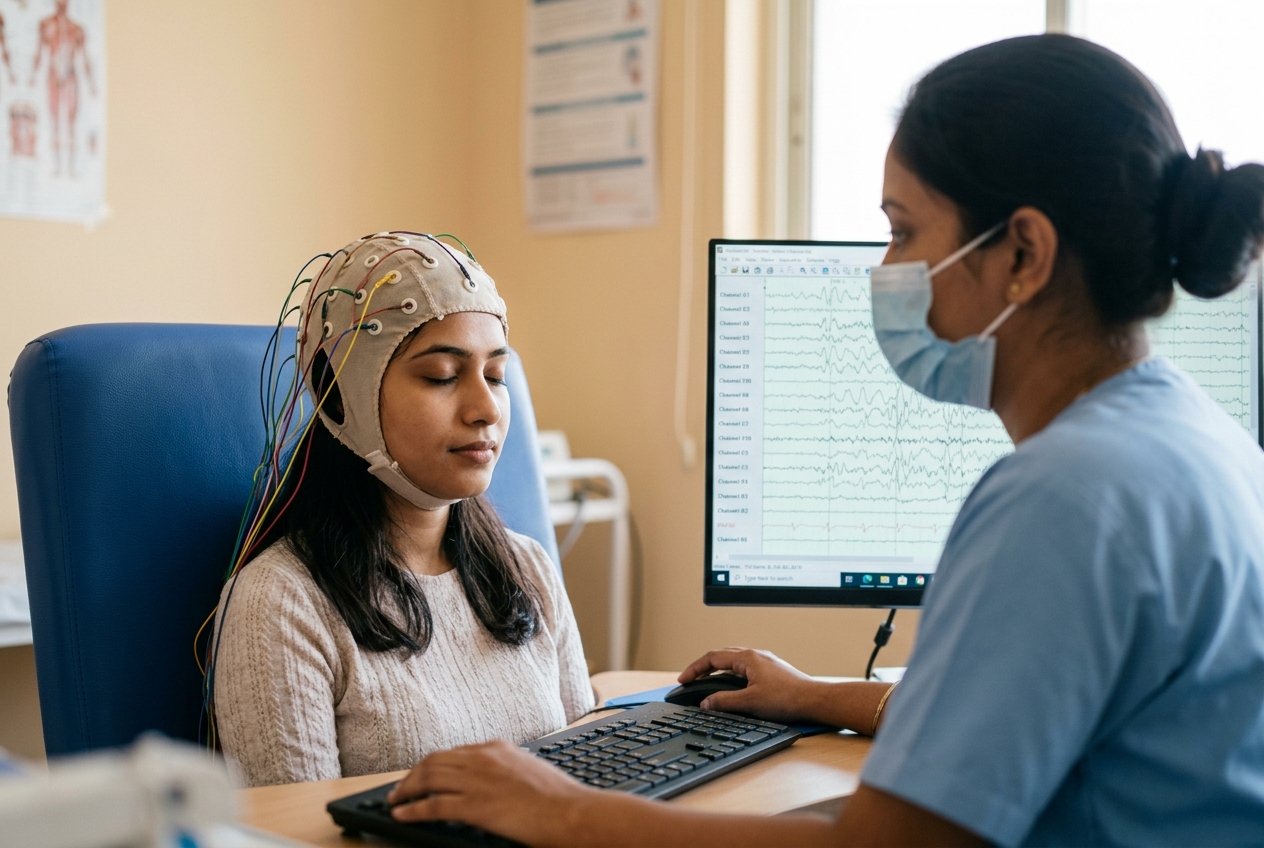
Before any psychiatric label is applied, we look for what a scan, an EEG or a blood test can explain — a tumour, a seizure focus, an old bleed, an autoimmune process. A label given without that check can follow a person for decades.
Reversible causes are ruled out first
Thyroid disease, B12 deficiency, Wilson's disease, uncontrolled diabetes, liver and kidney failure, steroids and other medicines can all produce depression, mania or psychosis. These are treatable at the cause — and routinely missed.
Trained specifically for this overlap
Dr. Kamlesh A. Shah holds an MD in Neuropsychiatry — the branch that exists precisely for brain disease presenting as psychiatric illness. Since 1989 this hospital has worked at that junction rather than at either edge of it.
Neuromodulation in-house
When medication is limited by a damaged or medically fragile brain, rTMS, tDCS and modified brief pulse therapy are available here in Bhavnagar — not a referral to another city.
What we treat
Conditions that sit between two specialities.
Epilepsy and seizure-related
- Depression, anxiety and psychosis occurring alongside epilepsy
- Mood and behaviour change caused by anti-seizure medication
- Post-ictal confusion, aggression and memory gaps
- Dissociative (functional) seizures — fits with a normal EEG
- Temporal lobe epilepsy presenting as personality or religious change
After head injury
- Irritability, short temper and personality change after an accident
- Memory, attention and planning difficulty — post-traumatic cognitive impairment
- Post-concussion syndrome: headache, dizziness, poor sleep, low mood
- Depression, apathy and loss of initiative following brain injury
- Post-traumatic epilepsy with behavioural disturbance
After stroke
- Post-stroke depression — affecting roughly one in three stroke survivors
- Apathy mistaken by the family for laziness or stubbornness
- Emotional incontinence — uncontrollable crying or laughing
- Vascular cognitive impairment and vascular dementia
- Anxiety and fear of a second stroke blocking rehabilitation
Parkinson's & movement disorders
- Depression and anxiety in Parkinson's disease, often preceding the tremor
- Visual hallucinations and delusions in advanced disease or from medication
- Impulse-control disorders caused by dopamine agonists — gambling, overspending, hypersexuality
- Wilson's disease presenting in a young person as psychiatric illness
- Tremor, tics and dystonia with associated obsessive symptoms
Memory, delirium & the medically ill
- Dementia and memory clinic assessment — diagnosis, staging and carer support
- Delirium: sudden confusion in ICU, post-operative and elderly medical patients
- Behavioural and psychological symptoms of dementia — suspicion, wandering, aggression
- Catatonia — not eating, not speaking, not moving, holding odd postures
- Psychiatric symptoms in cancer, dialysis, HIV and post-ICU recovery
Organic & functional presentations
- Autoimmune encephalitis — sudden 'madness' in a previously well young person
- Multiple sclerosis with depression, euphoria or cognitive change
- Thyroid disease, B12 deficiency and electrolyte disturbance causing psychiatric symptoms
- Steroid, anti-tubercular and other drug-induced psychosis
- Functional neurological disorder: paralysis, blindness, tremor or fits with normal scans
Warning signs
When psychiatric symptoms need a brain work-up.
Most mental illness needs no scan at all. But any of the following should stop a prescription and start an investigation — bring the patient in rather than waiting for the next review.
- First psychiatric episode after the age of 45, with no earlier history
- Sudden onset over days in a previously completely well person
- Fever, headache, seizures or neck stiffness alongside the behaviour change
- Visual hallucinations rather than voices
- Confusion that comes and goes through the day, worse at night
- Weakness, numbness, unsteady walking, double vision or loss of bladder control
- Rapid memory loss over weeks to months
- No response at all to two adequate trials of psychiatric medication
Sudden confusion with fever, headache or seizures is a medical emergency. Come the same day, or call +91 94275 60101.
Myth & fact
What families are told, and what is true.
Fits mean the person is mentally ill or possessed.
Epilepsy is a neurological condition caused by abnormal electrical activity in the brain — not spirit possession, not black magic, and not an intellectual disability. India carries roughly one-sixth of the world's epilepsy burden, yet a large share of patients still reach a faith healer before a doctor, and in parts of the country the treatment gap exceeds 90%. Around 70% of people with epilepsy become seizure-free on consistent medication. Time lost to bhuva and dora is the single most expensive part of this illness.
If the MRI and EEG are normal, the fits and the paralysis must be fake.
Functional neurological disorder is a genuine, involuntary malfunction of brain networks — imaging studies show activation patterns clearly different from people pretending. It is diagnosed by positive clinical signs, not by 'nothing else was found', and it is common: around one in five patients in neurology clinics. With explanation, physiotherapy and psychological therapy, roughly half to sixty percent improve substantially within a year. Telling such a patient they are acting is both wrong and harmful.
Low mood after a stroke or a brain injury is natural — nothing can be done.
Post-stroke depression affects about a third of survivors and is a direct consequence of the brain injury as much as of the circumstance. Untreated, it slows physical recovery, worsens disability and raises mortality. It responds to treatment, and treating it measurably improves rehabilitation outcomes. 'Of course he is sad, he had a stroke' is the sentence that keeps patients untreated for years.
Forgetfulness in old age is just age — there is nothing to check.
Normal ageing slows recall; it does not take away the ability to manage money, find the way home, or recognise family. Some causes of memory loss — B12 deficiency, hypothyroidism, depression, normal-pressure hydrocephalus, chronic subdural haematoma — are genuinely reversible when found early. Even in Alzheimer's disease, early diagnosis buys years of better function and lets the family plan rather than react.
A psychiatric diagnosis does not need scans or blood tests.
Most do not. But a first episode after 45, a sudden onset in days, visual hallucinations, fever, fluctuating confusion or any new neurological sign change that answer completely. Autoimmune encephalitis, brain tumours, Wilson's disease and thyroid disorders have all been treated for months as 'schizophrenia' or 'bipolar disorder'. Investigating the brain is not over-caution — it is the difference between a cure and a lifetime of medication.
Behaviour change in Parkinson's disease means dementia has set in.
Gambling, overspending, compulsive eating or hypersexuality appearing in a patient on dopamine agonists is usually a medication effect, not a moral collapse or dementia — and it settles when the drug is adjusted. Visual hallucinations likewise need a review of the prescription before any new diagnosis. Families carry enormous guilt about these symptoms that a single medication review can lift.
Our approach
How a neuropsychiatric case is actually worked up.
- 01
A proper history — including the family's version
What changed, in what order, and over how long. Old prescriptions, discharge summaries, scans and EEG reports are reviewed rather than repeated blindly. Families see what the patient cannot describe.
- 02
Neurological and mental state examination
Both are done in the same sitting — gait, tone, reflexes, eye movements and speech alongside mood, thought and cognition. Cognitive screening is formal, not guesswork.
- 03
Targeted investigation
MRI/CT, EEG, thyroid function, B12, electrolytes, liver and kidney function, copper studies or autoimmune antibodies — ordered where the clinical picture points, not as a blanket panel.
- 04
Treat the cause, then the symptom
A deficiency is corrected, a seizure focus controlled, an offending medicine withdrawn, an autoimmune process referred for immunotherapy. Psychiatric medication is then chosen around the brain disease and the body's other illnesses.
- 05
Neuromodulation when medication is limited
In a fragile brain — post-stroke, post-injury, elderly, multiple medical illnesses — rTMS, tDCS or carefully indicated mBPT often achieve what tablets cannot without unacceptable side-effects.
- 06
Family training and long-term follow-up
Carers are taught what the illness can and cannot control, how to respond to aggression or wandering, and when to return urgently. Review is scheduled, not left to the next crisis.
Frequently asked
Questions families bring to the first visit.
Bring the old reports. We will read them properly.
Scans, EEGs, discharge summaries and every prescription tried so far — the answer is often sitting in papers nobody has reviewed together.