Interventional Psychiatry
"Shock Treatment" Isn't What You Think — Understanding BPT and TMS
Dr. Dharmin Shah8 July 2026
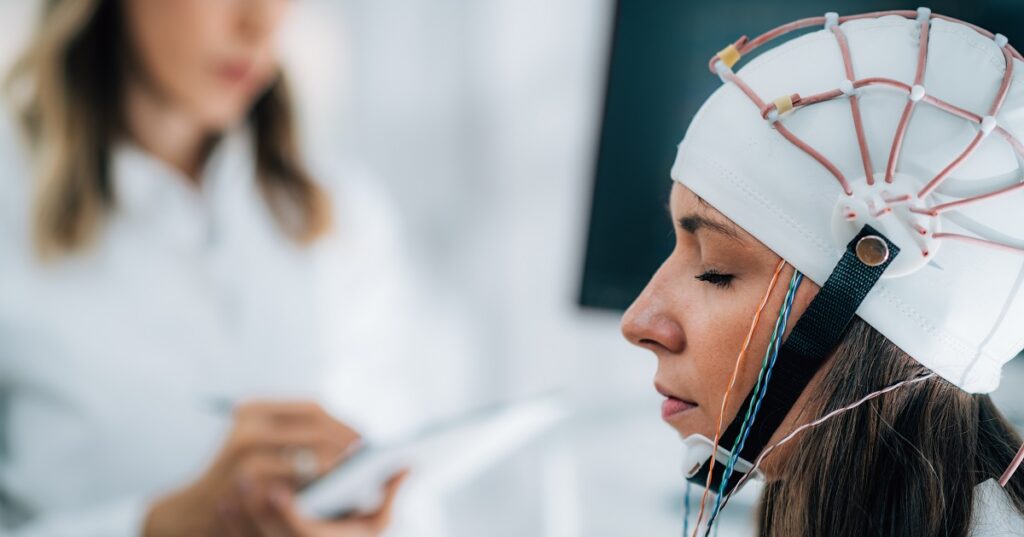
The words "shock treatment" still make most families flinch — and honestly, that's understandable. But what you've seen in old films and what actually happens in a modern neuropsychiatric hospital are two very different things. Here's the truth, explained simply.
Let's start with the fear, because it's real and it deserves to be taken seriously.
If someone in your family has been recommended ECT — or what is now more accurately called Brief Pulse Therapy (BPT) — your first instinct may be to say no. Maybe you've seen something in a film. Maybe you remember the words "Shock aapva na che" being used as something frightening, almost as a threat. That reaction makes complete sense. But before you make a decision based on decades-old images, you deserve to know what these treatments actually are today.
Where the fear came from:
In the early days of ECT — the 1940s and 1950s — the procedure was done very differently. Machines delivered a continuous, wave like electrical current (called a sine wave) directly to the brain, with no anesthesia and no muscle relaxants. Patients were conscious, experienced visible convulsions, and often woke up confused and distressed. It was, by today's standards, crude and yes, in some places it was misused as a tool of control rather than care.
Films cemented this image. The most famous example internationally is "One Flew Over the Cuckoo's Nest" — a 1975 Hollywood film where ECT is shown as punishment, not treatment. In India too, Bollywood has occasionally used "bijli ka ilaj" as a dramatic device, almost always portrayed in the darkest possible light.
The problem is that psychiatry moved on. Films didn't.
What actually changed — and why we now call it Brief Pulse Therapy (BPT)
The single most important shift happened when old sine-wave machines were replaced with modern devices that deliver electrical current in very short, precisely controlled pulses called brief pulses. This is why the treatment is now correctly referred to as Brief Pulse Therapy or Modified ECT (MECT) in India.
Here's what modern BPT looks like today:
The patient is given a short-acting general anesthesia. They are completely asleep and feel nothing. A muscle relaxant is administered, which means there are no visible convulsions whatsoever — the body remains still throughout. A carefully calibrated brief electrical pulse is then delivered, lasting just a fraction of a second. The brain responds therapeutically, the patient wakes up in a few minutes, and goes home or back to their room the same day.
That's it. No writhing. No restraints. No distress.
The change in technique also dramatically reduced the memory-related side effects that the old method was known for. The newer ultra brief pulse versions reduce these even further. NIMHANS in Bengaluru, India's premier psychiatric institution has been at the forefront of developing indigenous BPT devices and refining safe protocols for Indian patients.
BPT today is recommended for severe depression, treatment-resistant conditions, acute mania, catatonia, and certain cases of schizophrenia, situations where medication alone isn't working fast enough or at all, and it provides excellent results in recovery from this illnesses.
What about TMS — Transcranial Magnetic Stimulation?
TMS is an even newer addition to interventional psychiatry and works on a completely different principle. No electricity enters the brain. Instead, a gentle magnetic coil is placed against the scalp, and brief magnetic pulses stimulate specific nerve cells in the region of the brain involved in mood regulation.
There is no anesthesia. No seizure. No hospitalization. The patient sits comfortably in a chair, is fully awake, and a typical session lasts 20 to 40 minutes. Most people describe a soft tapping sensation on the scalp and nothing more.
TMS is particularly effective for depression that hasn't responded well to medications, and it has a well-established track record internationally, with approval from the US FDA since 2008.
So who are these treatments for?
They come into the picture when a patient needs faster stabilization. In those moments, they can be genuinely life-changing.
If you or someone you love has been recommended either of these, it's not a sign that things are hopeless. If anything, it's the opposite your doctor is committed to finding what works, and these are among the most effective tools modern psychiatry has.
We understand that questions and concerns are natural. At our hospital in Bhavnagar, we always take the time to sit with patients and families, explain the procedure step by step, and answer every question before anything begins. No one walks into a BPT or TMS session without fully understanding what to expect.
The goal is always the same to help you or the person you love find their way back to a life that feels livable again. The tools have changed enormously. That goal never has.
More from the journal

Child & Adolecent
The Silent Struggle in Every Classroom: A Parent and Teacher’s Guide to School Children’s Mental Health
Read
Mental Health
On World Suicide Prevention Day — Start the Conversation. It Can Save a Life.
Read
Deaddiction